
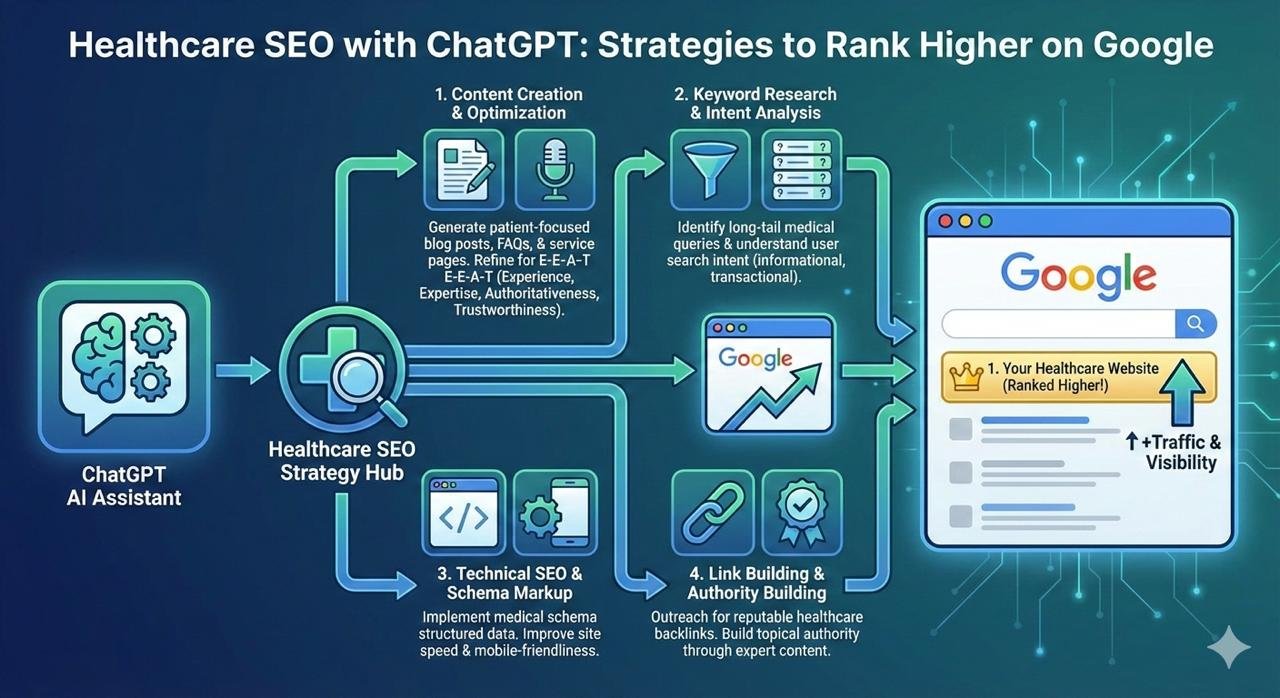
In today’s digital-first world, patients don’t just walk into a doctor’s office anymore—they Google it first. Symptoms? Googled. Treatment options? Googled. “Best doctor near me who won’t judge my web search history”? Definitely Googled.
For better or worse, Google is now the front desk of the healthcare journey.
If your practice isn’t showing up on the first page of search results, there’s a good chance those patients are booking appointments with a competitor who did befriend SEO – while you’re left wondering why the phone is so quiet.
And with AI chatbots like ChatGPT entering the chat (literally), Search Engine Optimization (SEO) is no longer just about stuffing keywords and collecting backlinks like Pokémon cards.
It’s evolved into a smarter, data-driven, intent-focused strategy – one that helps healthcare providers connect with the right patients at the right moment, instead of yelling into the internet void.
This article explores:
- The Importance Of SEO In Modern Healthcare
- How AI Chatbots Like ChatGPT Are Transforming SEO
- Proven SEO Strategies For Medical Practices
- How ChatGPT Helps You Rank Higher on Google
- Best Practices for Using AI in Healthcare SEO
- Recommended Tools to Use Alongside ChatGPT
- Step-by-Step ChatGPT SEO Workflow for Healthcare
- The Future of Healthcare SEO with AI
The Importance Of SEO In Modern Healthcare
Healthcare searches aren’t casual late-night scrolling – they’re urgent. When patients hit Google, it’s usually because something hurts, something’s confusing, or something needs fixing now.
This isn’t window shopping. This is “I need answers, and I need them right now” energy.
Some very real examples:
- “Best gynecologist near me”
- “IVF treatment cost in Kolkata”
- “Symptoms of thyroid disorder”
- “Dentist open today” (translation: right now, please)
Strong SEO helps healthcare providers:
- Show up when it actually matters
- Look credible instead of questionable
- Attract a steady flow of patient inquiries
- Spend less money chasing clicks with ads
- Build long-term digital authority that doesn’t disappear overnight
Google takes healthcare content very seriously and evaluates it using E-E-A-T principles:
- Experience
- Expertise
- Authoritativeness
- Trustworthiness
And because healthcare falls under “Your Money or Your Life” (YMYL) content, Google expects accuracy, reliability, and zero funny business.
In other words, great rankings go to providers who know their stuff and prove it online.
How AI Chatbots Like ChatGPT Are Transforming SEO
Traditional SEO was… a lot. Endless keyword research, manual content planning, and spreadsheets that somehow multiplied overnight. Enter AI – doing in minutes what used to take hours, and doing it without complaining.
AI tools like ChatGPT significantly boost both efficiency and strategic thinking by helping with:
- Advanced keyword research
- Search intent analysis (what people actually mean)
- Content outlines and first drafts
- FAQ creation (yes, all the questions)
- Topic clustering
- Meta titles and descriptions
- Internal linking ideas
- Schema markup suggestions
- Local SEO content
- Readability improvements that don’t sound robotic
Think of ChatGPT as a very smart SEO assistant—fast, tireless, and great at handling the heavy lifting – while you stay focused on strategy and expertise.
That said, in healthcare, AI should always support human knowledge, not replace it. Because when it comes to patient trust and medical accuracy, humans are still very much in charge.
Proven SEO Strategies For Medical Practices
1. Keyword Research with Search Intent
Great healthcare SEO starts with a simple question: What are patients actually typing into Google? Spoiler alert – it’s rarely just one word.
Patient searches usually fall into a few clear intent categories:
- Informational – symptoms, causes, and prevention
- Commercial – comparing treatments or costs
- Transactional – booking appointments
- Navigational – finding a specific doctor or clinic
ChatGPT helps streamline this process by:
- Generating long-tail keyword ideas
- Identifying real, patient-style questions
- Grouping keywords based on intent
- Uncovering related and supporting topics
Long-tail keywords tend to convert better because they reflect specific, high-intent needs. For example, someone searching for “pediatric dentist in Kolkata” is far closer to booking an appointment than someone who just types “dentist.”
2. Creating High-Quality Healthcare Content
When it comes to healthcare content, Google has a clear preference: helpful, accurate, and written with real patients in mind – not vague internet strangers.
ChatGPT can be a powerful support tool for creating:
- Educational blog posts
- Clear, easy-to-follow treatment guides
- Well-structured service pages
- Patient resource materials
- FAQ sections that answer the questions people actually ask
One very important rule:
Never publish AI-generated healthcare content without a human review. Ever.
Always double-check for:
- Medical accuracy
- Expert validation
- Compliance with healthcare standards and regulations
Think of AI as the assistant that brings speed and structure – while medical professionals bring the knowledge, judgment, and credibility that patients (and Google) trust.
3. Building Topic Clusters and Pillar Pages
Modern SEO isn’t about publishing random articles and hoping for the best. Google now rewards topical authority – showing that you truly know a subject, not just one tiny piece of it.
That’s where pillar pages and topic clusters come in. This strategy clearly signals expertise to search engines while making content easier for patients to navigate.
Example:
Pillar Page:
Diabetes Treatment and Management
Supporting Cluster Topics:
- Early symptoms of diabetes
- Diet plans for diabetic patients
- Diabetes prevention strategies
- Available treatment options
- When to see a specialist
ChatGPT can help by:
- Suggesting relevant cluster topics
- Identifying gaps in existing content
- Recommending smart internal linking strategies
This connected content structure helps search engines crawl your site more efficiently – and boosts your chances of ranking higher while delivering a better user experience.
4. Optimizing for Featured Snippets and “People Also Ask”
Google loves answering healthcare questions before users even click a website. Those featured snippets and “People Also Ask” boxes sit right at the top of search results – and landing there means instant visibility.
Optimizing for these spots can dramatically increase your reach and credibility.
ChatGPT helps by:
- Generating clear, concise answers
- Structuring content in a question-and-answer format
- Writing snippet-friendly paragraphs that get straight to the point
Example:
Question: What are the early signs of thyroid imbalance?
Provide a clear, well-structured response in 40–60 words that directly answers the question.
This format aligns perfectly with how Google selects featured snippets, increasing your chances of owning that prime real estate at the top of search results.
5. Writing SEO-Optimized Titles and Meta Descriptions
Your title tag and meta description are your first impression in search results – and yes, they matter a lot. Even the best content won’t get clicks if the headline doesn’t earn attention.
ChatGPT can help by generating multiple variations that smartly combine:
- Primary keywords
- Emotional triggers that resonate with patients
- Clear, patient-focused language
- Local modifiers for geographic relevance
When more users click your result, Google takes that as a strong relevance signal – often rewarding it with better rankings and greater visibility.
6. Strengthening Local SEO for Clinics and Hospitals
Healthcare is local by nature. When patients search, they’re usually looking for care close to home – not across the country.
ChatGPT can support local SEO efforts by helping create:
- Optimized Google Business Profile descriptions
- Location-specific landing pages
- City-focused service content
- Local FAQ sections that answer nearby patient queries
Examples of localized searches include:
- “Cardiologist in South Kolkata”
- “Orthopedic clinic in Ultadanga”
Pairing strong localized keywords with positive patient reviews greatly improves visibility in both Google Maps and organic search results – making it easier for nearby patients to find and trust your practice.
7. Developing FAQ Content for Conversational Search
Search isn’t just about keywords anymore – it’s about questions. With voice search and AI assistants on the rise, patients are speaking to search engines the same way they’d speak to a doctor.
Common examples include:
- “Is IVF painful?”
- “How long does it take to recover from gallbladder surgery?”
ChatGPT can help create robust FAQ sections that:
- Increase on-page engagement
- Directly address real patient concerns
- Expand keyword coverage naturally
- Improve eligibility for rich search results
When paired with FAQ schema, this approach enhances how your content appears in search – making it more visible, clickable, and patient-friendly.
8. Implementing Schema Markup
Schema markup is essentially a translator for search engines – it helps Google clearly understand what your content is about and how it should be displayed.
For healthcare websites, some of the most valuable schema types include:
- FAQ schema
- Medical condition schema
- Physician schema
- Local business schema
- Service schema
ChatGPT can assist by generating structured schema formats quickly, reducing technical guesswork and saving time – especially for teams without deep development resources.
When implemented correctly, schema improves content clarity, enhances search appearance, and strengthens overall SEO performance.
9. Enhancing User Experience and Readability
Google pays close attention to how users interact with your content. Metrics like time spent on page, bounce rate, and overall engagement help determine whether your page is actually useful – or quickly abandoned.
ChatGPT can help improve readability by recommending:
- Short, easy-to-scan paragraphs
- Clear and descriptive headings
- Bullet points for faster comprehension
- A logical content flow
- Strong introductions that hook readers early
When users find your content easy to read and genuinely helpful, they stay longer—and those positive signals often translate into stronger search rankings.
10. Supporting Multilingual and Regional SEO
In diverse and multilingual markets, speaking your audience’s language – literally – can dramatically expand your reach and impact.
ChatGPT can assist by:
- Translating content accurately and professionally
- Adapting messaging to fit local cultures and regional nuances
- Creating region-specific FAQ sections
- Maintaining a consistent brand tone across languages
Well-localized content builds stronger trust with patients and improves search relevance – making your healthcare services easier to find and easier to choose.
How ChatGPT Helps You Rank Higher on Google
ChatGPT supports SEO success by making it easier to execute best practices—consistently and at scale.
It helps enable:
- Faster content production without losing structure or clarity
- Deeper and more comprehensive topical coverage
- Stronger alignment with real search intent
- More consistent publishing schedules
- Smarter internal linking opportunities
- Better-crafted titles and meta descriptions
- Increased chances of appearing in featured snippets
It’s important to be clear: ChatGPT doesn’t “hack” or manipulate Google’s algorithm. Instead, it helps teams implement high-quality, patient-focused SEO strategies more efficiently – so the fundamentals are done right, every time.
Best Practices for Using AI in Healthcare SEO
When it comes to healthcare, accuracy isn’t optional – real people rely on this information to make real decisions. That’s why responsible AI use is critical.
Follow these best practices:
- Verify every medical fact before publishing
- Clearly highlight expert authorship and credentials
- Avoid exaggerated or misleading claims
- Reference authoritative and trusted sources
- Maintain transparency in content creation
- Regularly review and update outdated information
The strongest healthcare SEO strategies strike the right balance – using AI for speed and scale, while relying on medical professionals for accuracy, judgment, and trust.
Recommended Tools to Use Alongside ChatGPT
To get the best results, ChatGPT works best as part of a broader SEO toolkit—not as a standalone solution.
Pair it with trusted tools like:
- Google Search Console — to monitor search performance and visibility
- Google Analytics — to understand user behavior and engagement
- Ahrefs or SEMrush — for advanced keyword research and competitive insights
- SurferSEO — for on-page content optimization
- Yoast SEO — to support technical SEO improvements
- Google Business Profile — to strengthen local search presence
Together, these tools create a powerful, data-driven SEO ecosystem – combining AI efficiency with real-world performance insights.
Step-by-Step ChatGPT SEO Workflow for Healthcare
A structured workflow ensures AI supports SEO efforts without compromising quality or compliance.
Step 1: Conduct keyword research with a focus on search intent
Step 2: Build a pillar-and-cluster content strategy
Step 3: Draft content using AI-assisted tools
Step 4: Complete expert medical review and validation
Step 5: Optimize titles, meta descriptions, and internal links
Step 6: Implement relevant schema markup
Step 7: Strengthen local SEO signals
Step 8: Track performance and refine the strategy regularly
Consistency – not shortcuts – is what drives sustainable, long-term rankings in healthcare SEO.
The Future of Healthcare SEO with AI
Search is getting smarter, more conversational, and far more patient-centric. People now expect quick, accurate answers – not pages of guesswork.
Healthcare organizations that embrace AI-supported SEO today stand to gain:
- Stronger digital authority
- Greater patient trust
- Increased organic patient acquisition
- A sustainable competitive advantage
Those who wait risk falling behind, as search results become more competitive and expectations continue to rise.
AI chatbots like ChatGPT are transforming how healthcare providers approach SEO – bringing speed, intelligence, and scalability to what were once time-intensive processes.
When paired with expert oversight and thoughtful strategy, ChatGPT empowers healthcare brands to:
- Better understand patient intent
- Create authoritative, trustworthy content
- Improve search visibility
- Deliver a stronger user experience
- Build lasting patient trust
The formula for success is simple:
Strategic SEO + AI Capabilities + Human Expertise = Higher Google Rankings
Healthcare organizations that adopt this integrated approach won’t just rank higher in search results – they’ll establish themselves as trusted digital authorities in an increasingly competitive healthcare landscape.
How Godwin Digital Solutions Helps Healthcare Brands Win with SEO
As healthcare search becomes more competitive and patient expectations continue to rise, having the right digital partner makes all the difference.
Godwin Digital Solutions, a prominent digital marketing company in Kolkata, works closely with healthcare professionals and medical institutions to turn search visibility into real patient growth.
By combining proven SEO strategies, AI-powered workflows, and deep industry understanding, Godwin Digital Solutions helps healthcare brands:
- Improve Google rankings for high-intent medical searches
- Increase local and organic visibility across competitive markets
- Attract the right patients at the right time
- Build long-term digital authority and trust
- Stay compliant with healthcare SEO best practices
From clinics and diagnostic centers to hospitals and specialty practices, the focus is always the same: ethical SEO, measurable growth, and sustainable results.
If you’re a healthcare professional or medical institution looking to increase visibility, attract more patients, and stay ahead in an AI-driven search landscape, now is the time to act.
👉 Book a consultation with Godwin Digital Solutions and discover how a smart, SEO-first strategy can transform your online presence into a consistent patient acquisition channel.
Because in today’s healthcare journey, being found is just as important as being trusted in the marketplace.